
The necessity of a single man to eat outside food, is born out of a necessity than a regularity. More so for me, with my "good" cooking skills.
Although initially I used to get away with "decent" food, which to me meant pizza or an S-Class Restaurant. It takes wisdom under the bodhi tree at the end of a few months to realize the importance of frugality which then decides to re-align the definition of "decent". And with the new enlightened vision, you get to see hitherto unseen places to eat around you.
Once such selection is the R.R.I Mess. The mess is very similar to any mess you may have in your imagination. A house in the middle of nowehere in one of the crossings of the main road. A corridor that leads to a medium sized room, ideally stacked with long tables and chairs. No token-system. The owner sits outside the main hall, and that is probably to ensure that he has the right headcount, and the confidence that anyone going in has to come out some time (or day). A couple of large photos of gods with flowers around. The food starts with two chappatis, and curry. The plates are banana leaves. An unusual practice is for the servers to place a pinch of salt, and pickles first on the plate. I'm not very sure there do that but it happens with an eerie precision and regularity.
The rice comes in a bowl, and the rest of items are quickly laid out on the leaf. The service is quick silent, and efficent. The food costs onlt Rs15/-, so there is an assortment of gentlemen on every table. Yes. And there is a gentlemanly scramble for places to sit. People throw their hankies, towels to "reserve a palce while they go to wash their hands. Some daredevils and risk-takers, their mobile phones or watches (perhaps in the belief that the gods from the large pictures above are watching over).
The food is quintessentially south indian vegetarian with a Keralite Touch. Which is pleasing to my appetite. And the re-fuelling happens at a very fast pace. Only the rice and Papad are limited in quantity and need to be ordered extra if needed. But usually never, because the quantity is what I would call "ideal". More so for the bunch that comes here everyday. Once my table "partner" told me he came here every ewek from a place that was 25Kms away because he is now married (Apparently he used to hang out here when he was not).
The owner is a typical keralite (Combed Thick black oily hair, beard, checked full shirt and a dhoti). Genial guy, he sometimes gives "discounts" to regular customers (He waived Rs 5/- off once when I did not have change. And he was neveer to ask for it again). Once lunch is done, everyone is expected to gert up as soon as possible and stop loitering around the place to extend the courtesy to the waiting otheres.
Usually, the food ends with fennel seeds and a contented mind.....J
Showing posts with label Opinions. Show all posts
Showing posts with label Opinions. Show all posts
Saturday, July 21, 2007


Thursday, July 12, 2007
Zeitgeist: 2007 The Movie
Here is the movie - Kind of old, but new theory I would say.
The video editing is slick. The story boarding technique is typical where explosive and poignant images come up to shake the viewer, and make him/her mold-eable to a conclusion that is backed by sources. Unfortunately, the book-sources for Part I, II, and III include books that have been oft-quoted and heavily criticised (Acharya S, Gerald Massey anyone ?). Looking at it from the other side, this is a piece of brilliant storytelling, and an entirely believable concept. The problem being that "intellectuals" ask for imminent proof of open secrets (like who exactly benefits from the Oil war. BTW my next post would be a comparison of oil consumption in the US versus the rest of the world-believe the figures or not). And this may become one of the "Good Documentaries" that people watch and then forget over time.
The video editing is slick. The story boarding technique is typical where explosive and poignant images come up to shake the viewer, and make him/her mold-eable to a conclusion that is backed by sources. Unfortunately, the book-sources for Part I, II, and III include books that have been oft-quoted and heavily criticised (Acharya S, Gerald Massey anyone ?). Looking at it from the other side, this is a piece of brilliant storytelling, and an entirely believable concept. The problem being that "intellectuals" ask for imminent proof of open secrets (like who exactly benefits from the Oil war. BTW my next post would be a comparison of oil consumption in the US versus the rest of the world-believe the figures or not). And this may become one of the "Good Documentaries" that people watch and then forget over time.
Saturday, May 20, 2006
5 ways to start a company (without quitting your day job)
Almost everyone stuck in a cubicle dreams of starting his own business. Here are 5 ways to use your current gig to launch a new venture.
(Business 2.0 Magazine) - If you're reading this, there's a good chance that you've always wanted to launch your own startup. According to our research, roughly half of all Business 2.0 readers dream of founding their own companies.
Odds are, however, that you're still working for someone else. Maybe it's because you're afraid to give up that steady paycheck. Perhaps you're simply terrified by the thought of placing yourself at the mercy of greedy investors, cutthroat competitors, and a potentially indifferent marketplace. Whatever the reason, it's clear that there's a lot of unrequited entrepreneurial longing out there.
So we set out to see if we could help. We wondered, what if cubicle-bound employees could use their current gigs to launch new ventures? Of course, starting a company while employed by another one can be tricky -- especially if you've signed agreements promising not to compete with your employer or not to hire away colleagues. Indeed, in many cases anything you invent while collecting a paycheck can be considered the boss's property. James Geshwiler, managing director of CommonAngels, a Boston investment group, warns that from a legal perspective, cubicle entrepreneurs often "tread on very sensitive ground."
Still, working for a corporation affords access to several things that are vital to a fledgling company: money, customers, market research, personnel. And it turns out that many former wage earners have successfully exploited these resources -- legally, and in some cases with the assistance of their employers -- to realize their entrepreneurial dreams. Some actually built their startups while working for someone else, while others simply tapped previous employers' people and cachet.
All of them, however, learned to look at salaried life as a springboard rather than a prison. Daniel Curran, a management consultant who lectures on entrepreneurship at UCLA, suggests, "When you come across hidden customer demands in your job, turn them into a business."
Here are five ways to get started.
1. Use Your Salary as Funding
Gregory Moore financed his big idea one paycheck at a time.
The opportunity was obvious: Gregory Moore wanted to create a company that would securely transmit patient and payment data between hospitals, doctors, clinics, and insurers. In 2000 he took the proposal to software maker TeraHealth, which then hired him to make it a reality. But TeraHealth didn't pursue the effort, so Moore began building the business on the side. He used his salary to hire a coder and spent nights and weekends filing incorporation papers and creating sales brochures. He even set up a basic office.
The Monday after he left TeraHealth in March 2001, his new company, Harbor Healthcare, was open for business. Moore booked his first revenue about a month later. TeraHealth grumbled, but Moore had records proving that he'd hatched his idea long before he joined the company.
The key, he says, is "to use your salary to invest in the startup as much as possible before jumping ship." After five years and several rounds of angel funding, he still owns a majority of the firm's equity.
2. Turn Common Complaints Into a Business Plan
Jeff Gallino and Cliff LaCoursiere decided to give customers what they really wanted.
You know that feature your customers are always asking for? If your employer won't deliver it, maybe you should.
That's what Jeff Gallino and Cliff LaCoursiere did. Back in 2001 the two worked for ThinkEngine Networks, a Boston-based telecom equipment company. Gallino handled relationships with software partners, while LaCoursiere ran sales. The two kept hearing customers ask for a way to digitally sift through recorded calls and analyze them.
Gallino and LaCoursiere brought the idea to their employer, but they received a halfhearted response. So the duo wrote a business plan during off-duty hours and left ThinkEngine Networks in 2002. They funded their new firm, CallMiner, for a year with money saved from their salaries.
Gallino wrote the first version of their software, which builds an overall picture of what's being said through speech recognition, pattern mining, and signal analysis. The product attracted angel investment and a venture round, including cash from In-Q-Tel, the CIA's venture fund. Today, CallMiner's applications are used by airline, energy, and cable companies to categorize call-center calls, while government agencies are evaluating the technology's ability to automate intelligence gathering.
3. Make Your Boss a Beta Tester
David Bookspan invented a new service that his old firm just couldn't live without.
While working as a partner in a Philadelphia law firm during the 1990s, David Bookspan figured out how to use the local courthouse's lawsuit filings to drum up new business. Bookspan realized that if he could automate his system, he'd be able to create a lead-generation service that other lawyers would gladly pay to access.
The chairman at his firm felt the effort would distract from its core legal practice, but he let Bookspan develop it on his own. "Just be completely up front," Bookspan advises anyone with similar intentions. "View your employer as your friend."
He incorporated as MarketSpan in 1996 and stayed at the law firm for another year, working nights out of his home with a partner who was a software developer to create a marketable product. Four years later, with 88 of the nation's top 100 law firms (including his old employer) signed up as customers, his company was acquired by CourtLink (itself later bought by LexisNexis) for a reported $35 million.
4. Take Advantage of Your Company's Reputation
Dan Connors turned his pedigree into seed capital.
After 11 years at LucasArts, the videogame arm of Lucasfilm, Dan Connors decided that enough was enough. Hoping to make games that emphasized episodic storytelling rather than shoot-'em-up action, Connors was heartbroken when LucasArts killed his cartoon-based project to put more resources behind the firm's Star Wars franchise. At the same time, LucasArts was downsizing, so it was easy to quit.
Connors started out with one like-minded colleague in April 2004. They called their new venture Telltale and seeded it with cash from their severance packages. Then, over the next two years, as other former colleagues left LucasArts, Connors hired 15 of them.
Thanks to their LucasArts halo, Telltale had no problem finding clients. Within nine months it landed a deal to work with Ubisoft on a game based on TV's CSI. LucasArts's reputation also made it easier to raise $1.4 million in angel funding. Says Connors, "It's hard to overestimate the door-opening power of the LucasArts name."
5. Convert Your Employer Into a Business Partner
Jeff Hilbert spun a doomed division into a successful startup.
In 2002, when Jeff Hilbert was managing the design services division of Coventor, a chip-design software company in North Carolina, his unit was slated for the chopping block. However, Hilbert noticed that he had recently been winning a lot of business from wireless chip companies, so he asked Coventor to let him spin off the unit as a stand-alone company.
The board went for it and gave the startup -- now called WiSpry -- $6 million worth of patents and other intellectual property, seven employees, several hundred thousand dollars, and an office in Irvine, Calif., all in exchange for shares in the company. Today, Hilbert is CEO of WiSpry, which is developing a special chip for cell phones that could improve battery life by 20 to 40 percent. His advice: Don't rely too much on a parent company. Sooner or later, all startups must be able to fend for themselves.Tuesday, April 25, 2006
9/11: The real story
An amazing video on Google that shows the "real story" behind 9/11. A bit lengthy (1hr 20 mins) but worth watching.
|
Monday, April 24, 2006
A Window into Microsoft's Battle
Excellent Article.
A Layman's guide to the latest happenings on the Microsoft's EU Antitrust Case
Read more at www.businessweek.com/gl...
Sunday, April 09, 2006
Software Reviews
1) Trillian Basic 3.1 (http://www.ceruleanstudios.com/)
Rating - Thumbs Up
Rating - Thumbs Up
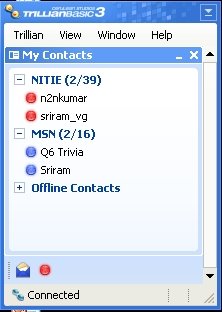
-This has got all the features of Y! and MSN messenger including audio and video chat
-Single window interface for all messengers
-Excellent user manual
1) Internet Explorer 7.0 (Beta 2 version, Released on March 20th 06')
(http://www.microsoft.com/windows/ie/ie7/ie7betaredirect.mspx)
Rating - Thumbs Down
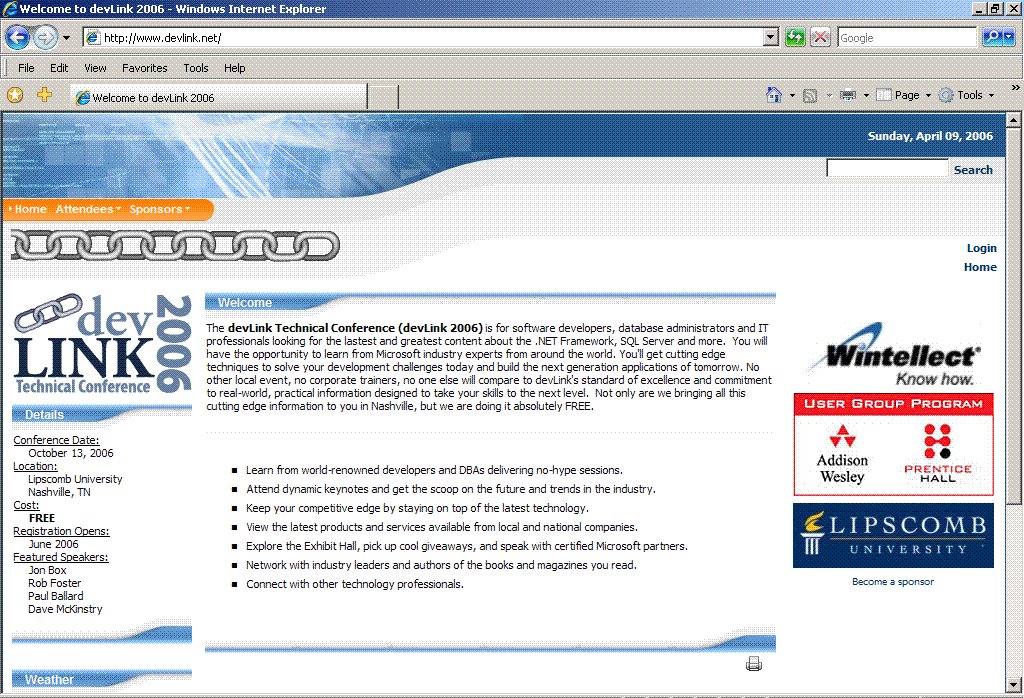
Copy cats ! - They lifted tabbed browsing from Mozilla/Netscape/Firefox.
Copy cats ! -They lifted side bar search from Firefox
Copy cats ! -They lifted add-ins/extensions concept from Firefox
It loads faster than IE 6.x, apart - nothing special
1) MW Snap (www.mirekw.com)
Rating - Thumbs Up

-The best Screenshott software ever !
-Single .exe file. No set up required
-Single select-click/copy/print/save option for fastest screenshots
1) Foxit Reader (www.foxitsoftware.com)
Rating - So-So

-Adobe Reader isn't your only option for viewing PDF files
- I love single .exe files without setup !
-No stupid piugins that load on the Adobe startup screen for an eternity. Takes a few seconds to spring up !
-Why dosen't the damn thing allow me to edit PDF files without putting u a stupid "eval" watermark on it !
1) CCleaner (www.ccleaner.com)
Rating - Thumbs up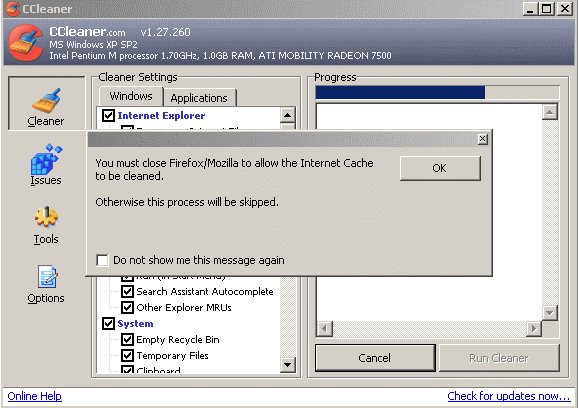
-Well, my only comment - My PC became much faster after I ran this !!
Saturday, April 01, 2006
Putting together the Airbus A380
A Behind the scenes look:
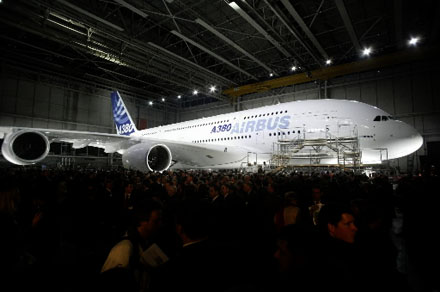
With the Airbus A380 scheduled to enter service at the end of this year, it won't be long before travelers will have a close look at the biggest passenger plane ever built. But the finished aircraft is only part of the A380 story. Equally fascinating are the logistics of building this double-decker behemoth. Climb aboard and take a peek
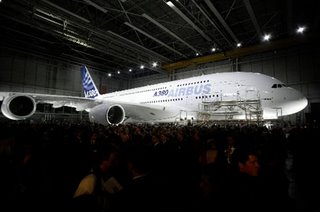
With the Airbus A380 scheduled to enter service at the end of this year, it won't be long before travelers will have a close look at the biggest passenger plane ever built. But the finished aircraft is only part of the A380 story. Equally fascinating are the logistics of building this double-decker behemoth. Climb aboard and take a peek
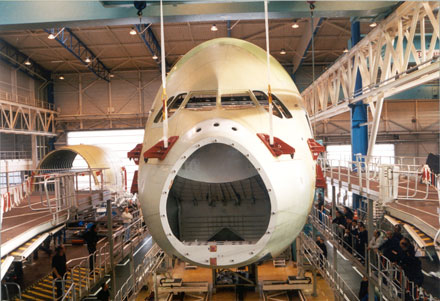
A Big, Big Nose Job
Workers inspect the nose section of an A380 under construction at St. Nazaire, on France's Atlantic coast. Sections of the fuselage are built at this factory, then shipped by sea, river, and highway for final assembly in Toulouse.
Flying Beluga
In Stade, Germany, an A380 tailfin is loaded onto a transport plane. The plane, nicknamed the Beluga because of its bulbous profile, can accommodate the 24.1-meter-high tailfin, which is longer than the wing of a Boeing 737 or Airbus A320. But other A380 parts are too big and have to be shipped by land or sea.
Winging It
An A380 wing under construction at an Airbus factory in Broughton, North Wales. A new factory had to be built to accommodate the 46-meter-long wing, which is taller than a nine-story building.

What's "Megaplane" in Welsh?
A ferry carries an A380 wing down the River Dee from the Broughton wing factory. What's that AFON DYFRDWY painted on the side of the boat -- a serial number? No, it's Welsh for "River Dee."
Wings Over Water
With a pair of A380 wings stowed in its hold, a ferry steams toward the mouth of the Garonne River in France, enroute from Wales. The oceangoing ferry, christened the Ville de Bordeaux, was custom-built for Airbus at a Chinese shipyard.
Historic Passage
A barge carrying an A380 wing passes under the 19th-century Pont de Pierre on the Garonne River in Bordeaux, France. The pilings of the historic bridge were reinforced to guard against collisions with barges carrying pieces of the megaplane.
Wide Load Ahead
Custom-built flatbed trucks ferry A380 parts from Bordeaux to Toulouse. Airbus and the French government split the cost of widening and straightening this highway, which is closed to traffic several nights a month so the convoys can pass.

Touchdown
Sixteen Football Fields could fit inside the A380 assembly plant in Toulouse. Five test aircraft have already been built here, and construction is under way on A380s to be delivered by the end of this year to Singapore Airlines, the first customer.
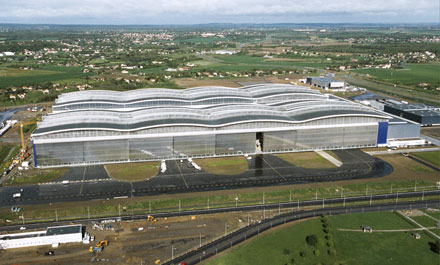
Roll 'em In
Workers help roll a chunk of A380 fuselage into place at the Toulouse assembly plant. Note the three levels inside the fuselage: Two passenger decks, with a cargo hold at the bottom.
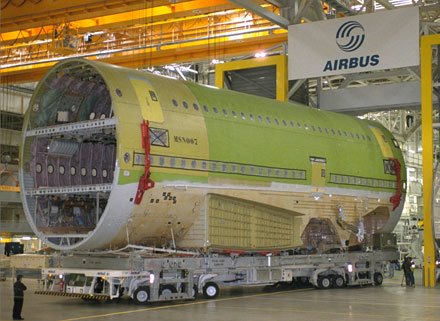
Snap 'em Together
O.K., it's a little harder than putting together a Lego toy, but with the wings and fuselage built elsewhere, final assembly in Toulouse takes surprisingly little time. Airbus says it expects to build four A380s per month after production ramps up next year.
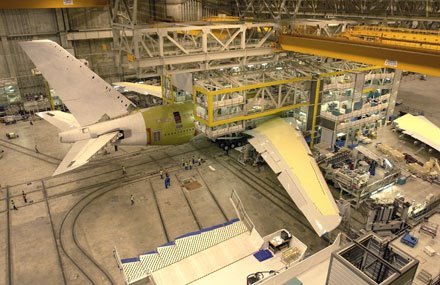
Roll 'em Out
A finished A380, one of five test aircraft, being towed onto a runway at Toulouse. It will be flown to another Airbus facility in Hamburg, Germany, for painting and interior outfitting.

Paint Job
Workers in Hamburg paint the exterior of an A380. What will the megaplane's interior look like? That's a secret, closely guarded by Airbus and the carriers that will start flying the plane next year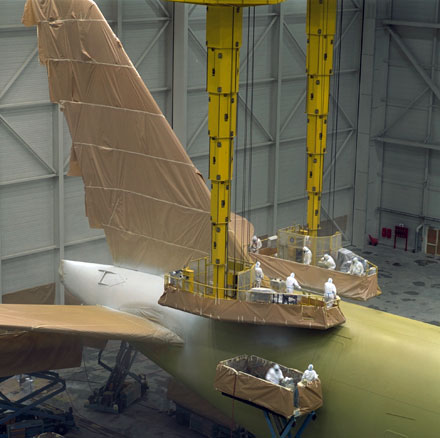
Takeoff!
An A380 heads skyward at the Asian Aerospace air show in Singapore in February. The plane, though painted with the livery of launch customer Singapore Airlines, is actually one of several test models
Sunday, January 22, 2006
Book Review: The Christ Conspiracy: The Greatest Story Ever Sold, by S Acharya
The combination of the book's title and the Author's name may lead to believe that this book is the result of extreme Indian right wing ideology emanating in a book ? (I have reproduced content from the book in my own words, in this blog)
Wrong. Acharya S is the pen name of D. Murdoch. In this book, she proponents a Christ-myth hypothesis. The premise being that the modern Christianity religion is the result of eons of plagiarism and myth intermittently shrouding each other, originally intended to unify the Roman state and establish the Roman supremacy by uniting people of Europe into a single religion. Especially the fact that the Sun has attracted the attention of mankind from the very beginning of human history. Every religion considers the sun as one of the supreme being either directly or indirectly. And also all regions are influenced by astronomy. Christianity is no different. What does the Sun have to do with Christianity and astronomy ? Here are some reasoning's given here.
1) Jesus Christ was born December 25.. Now from the Northern hemisphere..the sun dies every year and goes South and at the cross of equator or the crossification(crucifixion) of the Sun, the Sun becomes weakened ..and continues sinking to tropic of Capricorn..but it stops going South on Dec 22 and reaches solar standstill and is dead/motionless for 3 days just like Jesus dies for 3 days..and is resurrected/reborn 3 days later on the Dec 25 and starts its journey back to the north..
2) The Resurrection of Jesus/Sun are similar because on the 25th is the first day the Sun moves 1 degree north from 22.5 degrees South...the Sun is reborn and it is a day of rejoicing for people in the North..
3) Great etymology example of which she has so many:helio biblia in Greek means holy bible in English...the "Sun book" has become holy Bible..
4) All religions have their saviors born on Dec 25 Krishna (this one obviously is not a very correct information), Dionysis the Greek god of Wine, Osiris Egypt savior god and Zaruthustra of Zorastriasm Persia all born the 25 of Dec..and Hercules and his 12 labors are associated with the signs of zodiac..
5) Why was Jesus born in a barn in a manger between a horse and a goat? The horse is Sagitarrius and the goat is Capricorn the 2 signs surrounding December 25...
Interesting ? Here are is more. Jesus is not one character but a character drawn from prophets/god-incarnates from various cultures - Horus:Egyptian Sun-god, Dyonsius, Attis, Mithras, including several others; Also Krishna(?) More examples:
1) Horus' earthly father was 'Seb' (Joseph), and was of royal descent; He had 12 disciples; Delivered a "sermon on the mount" to his followers; Was crucified between two robbers, buried in a tomb for 3 days, and resurrected
2) Krishna was a cowherd by profession; Angels in both cases issued a warning that the local dictator planned to kill the baby and had issued a decree for his assassination. The parents fled. Mary and Joseph stayed in Muturea; Krishna's parents stayed in Mathura.
3) (Although I know that Srimad Bhagavatham and Vishnu Puranam do nto say this) Some accounts describe Krishna to be pinned to a tree with arrows and being resurrected later with his mortal remains having vanished.
4) Persian Apostle Mithras had 12 desciples; Virgin birth; Resurrection
Although books like this are bound to be authortative, this book seems to wallow in the same, which lies in its conclusions, which is considered supreme and beyond doubt (No other alternative possible ?) In conclusion, for a light reading, it is good (Do not expect this to change the hardliners' stance on Jesus). The book does gives an interesting reading. It has got to do nothing with my religious beliefs or my orientation. Just that it interests me that there is another angle to all of this.
Here are some links if you are interested
http://en.wikipedia.org/wiki/The_Jesus_Mysteries
http://en.wikipedia.org/wiki/The_Jesus_Puzzle
http://en.wikipedia.org/wiki/Jesus-Myth
http://www.jesuspuzzle.com/
http://www.truthbeknown.com/
Wrong. Acharya S is the pen name of D. Murdoch. In this book, she proponents a Christ-myth hypothesis. The premise being that the modern Christianity religion is the result of eons of plagiarism and myth intermittently shrouding each other, originally intended to unify the Roman state and establish the Roman supremacy by uniting people of Europe into a single religion. Especially the fact that the Sun has attracted the attention of mankind from the very beginning of human history. Every religion considers the sun as one of the supreme being either directly or indirectly. And also all regions are influenced by astronomy. Christianity is no different. What does the Sun have to do with Christianity and astronomy ? Here are some reasoning's given here.
1) Jesus Christ was born December 25.. Now from the Northern hemisphere..the sun dies every year and goes South and at the cross of equator or the crossification(crucifixion) of the Sun, the Sun becomes weakened ..and continues sinking to tropic of Capricorn..but it stops going South on Dec 22 and reaches solar standstill and is dead/motionless for 3 days just like Jesus dies for 3 days..and is resurrected/reborn 3 days later on the Dec 25 and starts its journey back to the north..
2) The Resurrection of Jesus/Sun are similar because on the 25th is the first day the Sun moves 1 degree north from 22.5 degrees South...the Sun is reborn and it is a day of rejoicing for people in the North..
3) Great etymology example of which she has so many:helio biblia in Greek means holy bible in English...the "Sun book" has become holy Bible..
4) All religions have their saviors born on Dec 25 Krishna (this one obviously is not a very correct information), Dionysis the Greek god of Wine, Osiris Egypt savior god and Zaruthustra of Zorastriasm Persia all born the 25 of Dec..and Hercules and his 12 labors are associated with the signs of zodiac..
5) Why was Jesus born in a barn in a manger between a horse and a goat? The horse is Sagitarrius and the goat is Capricorn the 2 signs surrounding December 25...
Interesting ? Here are is more. Jesus is not one character but a character drawn from prophets/god-incarnates from various cultures - Horus:Egyptian Sun-god, Dyonsius, Attis, Mithras, including several others; Also Krishna(?) More examples:
1) Horus' earthly father was 'Seb' (Joseph), and was of royal descent; He had 12 disciples; Delivered a "sermon on the mount" to his followers; Was crucified between two robbers, buried in a tomb for 3 days, and resurrected
2) Krishna was a cowherd by profession; Angels in both cases issued a warning that the local dictator planned to kill the baby and had issued a decree for his assassination. The parents fled. Mary and Joseph stayed in Muturea; Krishna's parents stayed in Mathura.
3) (Although I know that Srimad Bhagavatham and Vishnu Puranam do nto say this) Some accounts describe Krishna to be pinned to a tree with arrows and being resurrected later with his mortal remains having vanished.
4) Persian Apostle Mithras had 12 desciples; Virgin birth; Resurrection
Although books like this are bound to be authortative, this book seems to wallow in the same, which lies in its conclusions, which is considered supreme and beyond doubt (No other alternative possible ?) In conclusion, for a light reading, it is good (Do not expect this to change the hardliners' stance on Jesus). The book does gives an interesting reading. It has got to do nothing with my religious beliefs or my orientation. Just that it interests me that there is another angle to all of this.
Here are some links if you are interested
http://en.wikipedia.org/wiki/The_Jesus_Mysteries
http://en.wikipedia.org/wiki/The_Jesus_Puzzle
http://en.wikipedia.org/wiki/Jesus-Myth
http://www.jesuspuzzle.com/
http://www.truthbeknown.com/
Subscribe to:
Posts (Atom)
